
You have no items in your shopping cart.
Immunology & Disease Pathology
Autoimmunity
Understanding the breakdown of central and peripheral tolerance mechanisms that lead to pathological self-reactivity.
Autoimmune diseases are pathological conditions where the body's immune system fundamentally dysregulates and attacks itself, erroneously mistaking its own cells, tissues, and proteins for foreign invaders.
Clinical susceptibility to certain severe autoimmune diseases—such as multiple sclerosis (MS) and systemic lupus erythematosus (SLE)—is potentially inheritable and strongly linked to specific genetic loci (like HLA alleles). Furthermore, environmental factors such as severe viral/bacterial infections, parasitic exposure, chemical agents, and even specific pharmacological drugs have been definitively linked to autoimmune disease development. Demographically, women have also been shown to be significantly more susceptible to pathological autoimmunity than men, often due to complex hormonal and genetic factors.
1. How Do Autoimmune Diseases Develop?
In healthy immune regulation, our bodies actively rely on two major overarching mechanisms to prevent the development and release of potentially harmful, self-reactive immune cells. In the vast majority of autoimmune diseases, either autoantibodies (produced by dysregulated B lymphocytes) or autoreactive T lymphocytes are primarily responsible for the resulting tissue damage.
2. Mechanisms of Tolerance
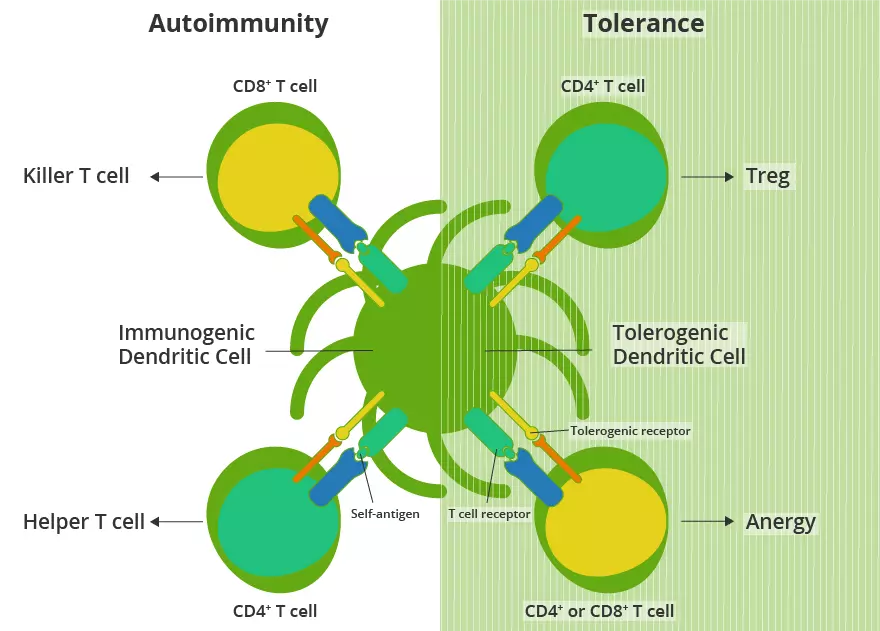
The immune system utilizes "tolerance" to ensure it does not attack the host. A breakdown in either of the two distinct tolerance phases leads directly to autoimmunity.
Central Tolerance
Central tolerance begins deep within the primary lymphoid organs (the bone marrow and thymus) during initial cellular development.
- B Lymphocytes: Immature B cells in the bone marrow whose B cell receptors (BCRs) strongly recognize self-antigens are typically negatively selected by either clonal deletion (apoptosis), receptor editing, or they are forced into a permanent state of anergy (unresponsiveness).
- T Lymphocytes: T cells begin their maturation in the thymus. Any T cells found to strongly bind native host proteins or cells receive immediate apoptosis signals. Only those T cells that do not recognize potentially harmful peptides are allowed to exit into the periphery and fully mature.
Peripheral Tolerance
Central tolerance is not a perfect mechanism; some self-reactive cells inevitably escape. Peripheral tolerance occurs in the immune periphery (blood, lymph nodes, spleen) where secondary mechanisms are constantly in place to remove or suppress any weakly self-reactive B and T cells that managed to escape central tolerance.
While B cell peripheral tolerance has not been fully characterized, it is understood that autoreactive T cells discovered in the periphery can be subject to either secondary clonal deletion, targeted conversion into suppressive Regulatory T cells (Tregs), or active induction into an anergic state.
The Breaching of Tolerance
Despite these massive, intricate regulatory systems designed to prevent autoimmune cells from surviving, low levels of autoantibodies and self-reactive T cells can actually be detected in the general population, even in the complete absence of clinical autoimmune disease. For a disease to formally present, these self-targeting cells must actually cause pathological or physical damage to tissues and/or organs. Therefore, it is currently understood by immunologists that individuals who develop a symptomatic disease have suffered catastrophic breaches of both central and peripheral tolerance mechanisms.
3. How is Autoimmunity Detected?
Detecting the presence of specific autoantibodies in patient serum has been the traditional, primary diagnostic biomarker for autoimmune conditions to date. This is due in large part to the ease, speed, and cost-effectiveness of conducting antibody tests in clinical settings compared with complex cellular T cell assays.
The most common initial diagnostic antibody test, the anti-nuclear antibody (ANA) test, heavily screens an individual’s serum sample against highly conserved antigens located in the nucleus of human epithelial cells (typically HEp-2 cells).
Diagnostic Visualization Methods
There are a massive variety of established laboratory methods that can be utilized to reliably detect and visualize autoreactive antibodies, including:
- Enzyme-linked immunosorbent assays (ELISAs)
- Immunofluorescence (IF)
- Western blotting (WB)
- Chemiluminescence Assays
- Nephelometry
Fluctuating levels of specific autoantibodies can powerfully indicate active disease progression. However, it is important to note that often individuals with an underlying autoimmune disease present initially without any positive antibody tests, but slowly develop clearly detectable serum antibodies as time goes on and tissue damage exacerbates the response. Depending entirely on the specific disorder, advanced diagnostics may include aggressively looking for one single specific antibody or a complex diagnostic panel of multiple associated antibodies.
4. What Treatments are Available?
Currently, the two leading therapeutic treatments available consist almost entirely of dampening or suppressing the hyperactive immune system using either powerful non-steroidal anti-inflammatory drugs (NSAIDs) or aggressive systemic immunosuppressives (such as corticosteroids or targeted biologics).
However, these are not cures. With more than 80 distinct autoimmune conditions currently identified, clinical scientists are aggressively focusing global research efforts on understanding the deep underlying genetic and molecular causes of the disease and its progression. Researchers are heavily investigating completely new methodologies for targeted treatments and therapies. Massive modern advances in targeted gene therapies, stem cell-based immune-reset treatments, and even novel transplantation techniques are all extremely promising leads in the vital search for permanent solutions to the massive global burden of autoimmune disease.
Advancing Autoimmunity Research
Immune dysregulation can aggressively lead to highly destructive autoimmune diseases, despite the incredibly careful evolutionary mechanisms natively in place to prevent their occurrence. Scientists are still heavily investigating the underlying molecular reasons for the catastrophic loss of immune tolerance and precisely how to combat specific disease progression or even intervene clinically before the disease has an opportunity to irreversibly damage host tissue.
Biorbyt is proud to support this critical research with an massive range of highly validated Immunology and Apoptosis related primary antibodies, recombinant proteins, and ELISA quantification kits.