
You have no items in your shopping cart.

Assay Reagents & Development
Matched Antibody Pairs
Understanding capture and detection antibody sets for high-sensitivity sandwich ELISAs and Lateral Flow Assays.
Matched antibody pairs are coordinated sets of two distinct antibodies that specifically target non-overlapping regions or unique epitopes on the exact same antigen of interest.
In a standard sandwich Enzyme-Linked Immunosorbent Assay (ELISA), the first antibody is coated onto the microplate surface as the capture antibody to immobilize the target protein from complex biological matrices. The second antibody functions as the detection antibody (conjugated to an enzyme or fluorophore), "sandwiching" the target antigen for precise quantitative measurement.
Monoclonal & Polyclonal Pair Formats
Matched pairs can utilize monoclonal antibodies, polyclonal antibodies, or a combination of both. High-affinity monoclonal detection antibodies offer exceptional specificity for distinguishing minor antigen variations, whereas adsorbed polyclonal capture antibodies maximize total antigen binding capacity. For large proteins presenting repeating epitopes, self-sandwiching antibody pairs may also be used.
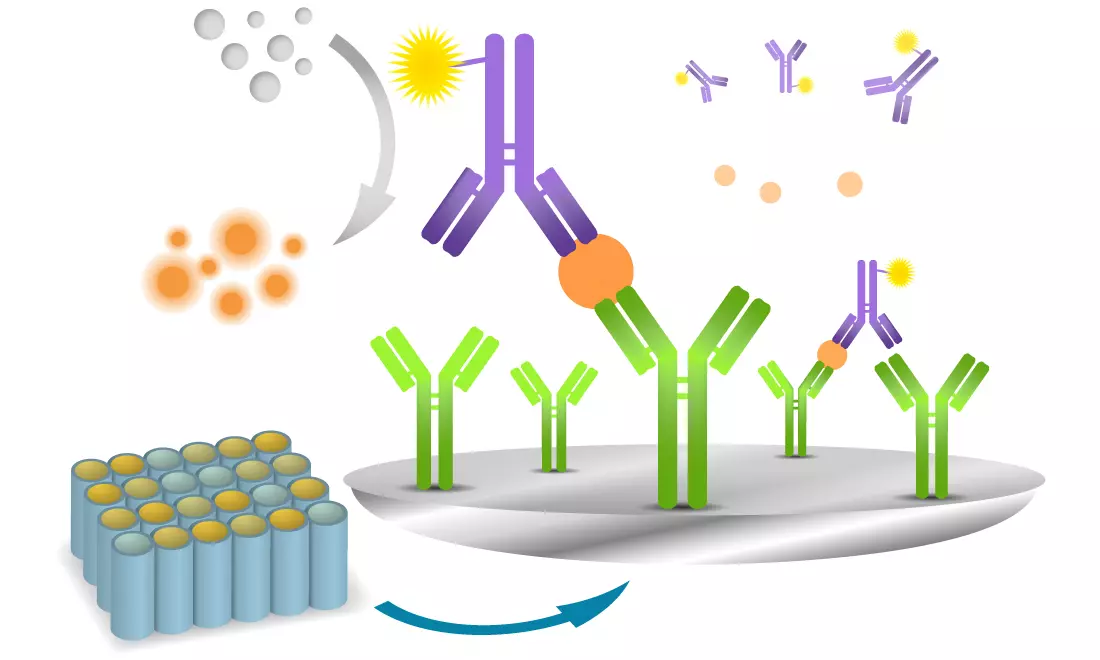
Sandwich ELISA Immunoassay Workflow: Capture Antibody → Target Antigen → Conjugated Detection Antibody.
1. Advantages of Sandwich ELISAs
Originally introduced in 1971, immunoassay methodologies include direct, indirect, competitive, and sandwich formats. The sandwich ELISA configuration offers clear technical benefits:
- 2x to 5x Higher Sensitivity: Dual-antibody sandwiching yields significantly higher signal amplification compared to standard direct or indirect methods.
- Enhanced Target Specificity: Requiring two distinct binding events eliminates non-specific background signals and prevents cross-reactivity.
- Direct Testing of Complex Samples: Crude biological samples (plasma, serum, cell lysates, saliva) can be analyzed directly without prior antigen purification.
- Flexible Detection Formats: Compatible with direct enzyme conjugation or biotin-streptavidin secondary signal amplification.
- Cross-Platform Application: Matched pairs optimized for ELISA are frequently adaptable to Lateral Flow Assays (LFA) and multiplex microfluidic platforms.
2. Selecting Matched Antibody Pairs for Your Project
Successfully developing a custom sandwich ELISA or lateral flow test requires validating epitope compatibility and screening for cross-reactivity:
- Epitope Non-Interference: Confirm that the capture and detection antibodies bind spatially distinct epitopes without steric hindrance.
- Cross-Reactivity Testing: Ensure neither antibody cross-reacts with common serum proteins or related family isoforms.
- Species Compatibility: Match your antibody species (e.g., Human, Mouse, Rat, Goat) to your experimental sample type and secondary conjugate detection systems.
When sourcing pre-validated matched antibody pairs from Biorbyt, capture and detection combinations arrive pre-screened and ready for assay development.
Need Guidance on Matched Pair Selection?
Biorbyt’s scientific support team can help you identify compatible capture and detection pairs or select pre-formulated ELISA kits for your research targets.
Contact Scientific Support