
You have no items in your shopping cart.

Neuroscience & Cell Signaling
Neurodegenerative Diseases
Understanding the pathology, underlying neuroinflammation, and emerging therapeutics driving neuroscience research.
1. Overview
A Neurodegenerative disease (NDD) is an illness inherently involving the progressive death or disorder of specific parts of the brain and the Central Nervous System (CNS).
People often get understandably confused about the clinical difference between Alzheimer's disease and dementia. Dementia is a syndrome (a complex group of related symptoms) actively associated with an ongoing decline of brain functionality observed universally in neurodegenerative conditions. There are many distinctly different pathological causes of dementia, with genetics and environmental exposures playing major roles in the progression of NDDs. The most common neurodegenerative disorders are broadly classified as amyloidosis, tauopathies, and α-synucleinopathies.
The Scale of Neurodegeneration
Current research shows there are presently more than 850,000 people in the UK alone who suffer from some form of dementia. Statistically, one in 14 people over the age of 65 is directly affected by dementia, and the condition aggressively impacts 1 in 6 people over the age of 80. Due to global increases in life expectancy, the raw number of people suffering from dementia is exponentially increasing. It is conservatively estimated that by 2025, the number of people presenting with dementia in the UK will easily surpass 1 million.
2. Symptoms of NDDs
While the specific clinical presentation depends heavily on the regions of the brain most impacted by the underlying disease, common symptoms of neurodegenerative diseases include:
- Progressive memory loss.
- Significantly decreased mental agility, focus, and clarity.
- Severe language processing issues and aphasia.
- Fine motor control skills dysfunction and broader movement impairment.
- Muscular atrophy occurring directly due to impaired mobility.
- Highly disruptive behavioral, personality, and mood issues.
3. Pathology & Mechanisms
Environmental factors, such as the excessive consumption of alcohol and prolonged, heavy exposure to certain aluminum-based compounds, have been shown epidemiologically to increase the likelihood of developing dementia. However, genetic factors also play a profoundly important role. Deep molecular research shows that inheritable mutations in critical genes such as PINK-1, Parkin, and Amyloid-Beta severely increase the active incidence of neurodegeneration in genetic carriers.
| Pathology Class | Underlying Mechanism |
|---|---|
| Amyloidosis |
|
| Tauopathies |
|
| Synucleopathies |
|
4. Neuroinflammation in NDDs
Neuroinflammation physically refers to the acute and highly destructive continued activation of the CNS immune system, a process primarily driven by resident glial cells such as Astrocytes and Microglia.
The Role of Astrocytes
Astrocytes are fundamentally responsible for the careful maintenance of neuronal intracellular levels of glutathione (GSH) and serve as the physical foundation of the blood-brain barrier. GSH is a major cellular antioxidant; it is actively involved in complex intracellular detoxification and the aggressive removal of highly destructive Reactive Oxygen Species (ROS).
The Role of Microglia
Microglia are resident phagocytic cells that actively facilitate the safe removal of aged, necrotic tissues and toxic molecular aggregates from circulation within their immediate surroundings when properly activated.
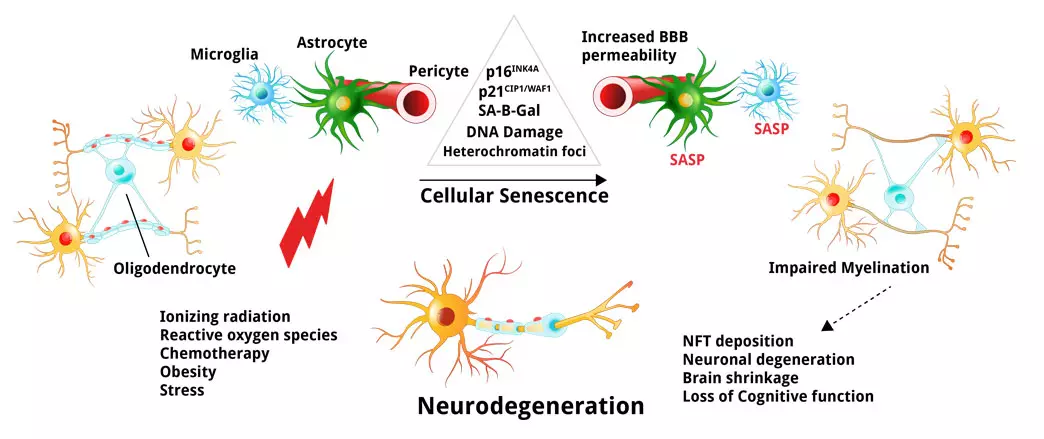
When an injury, toxic aggregate, or perceived threat is detected by the CNS immune cells, the resulting reactive activation causes the immediate transcription of numerous highly proinflammatory mediators, heavily including the transcription factor families NF-κB and STAT. Left unchecked, this aggressive response will result in severe collateral damage to neural tissue, typically seen in advanced neurodegenerative disorders due to the sustained, unyielding immunological attack on host cells.
5. Emerging Therapeutics: ISRIB
ISRIB (Integrated Stress Response Inhibitor) is a highly promising experimental drug that has been clinically observed to completely reverse the devastating effects of eIF2α phosphorylation. It was originally discovered by the Walter lab at UCSF through the semi-automated, high-throughput screening of a vast variety of small molecules.
ISRIB has been clearly shown to aggressively inhibit eIF2α phosphorylation-induced stress granule (SG) formation. Since active eIF2α phosphorylation is known to be intimately involved in physical memory formation, ISRIB was subsequently tested for in vivo neuro-activity, during which time it was remarkably found to readily cross the highly restrictive blood-brain barrier.
ISRIB Treatment and Memory Loss: A Possible Treatment for Alzheimer’s?
Subsequent pharmacological testing in 2013 found that ISRIB produced a profound, significant nootropic effect in mice, measured directly by the massive enhancement of both spatial and fear-associated learning in standard water maze and complex conditioned environment tests.
Further advanced testing in 2017 showed the experimental drug drastically improved the physical ability of brain-injured mice to successfully learn and form new memories during rigorous memory tests. This was specifically noted as appearing to actively reverse the deep cognitive impairments resulting from traumatic brain injury. Further recent studies have shown that ISRIB treatment also rapidly corrects spatial memory deficits and massively improves working memory in aged mice.