
You have no items in your shopping cart.

Virology & Infectious Diseases
Novel Spike Protein: D614G Variant
Understanding the dominant SARS-CoV-2 mutation and exploring Biorbyt's high-quality trimeric recombinant protein for COVID-19 research.
The original Wuhan strain of COVID-19 is no longer the dominant circulating virus in the global pandemic landscape. A heavily adapted variant carrying a D614G mutation in the Spike (S) protein of SARS-CoV-2 emerged at a very early stage of the pandemic and quickly became one of the most highly prevalent forms globally (1).
Korber et al. reported that this D614G variant may be substantially more virulent, often presenting with dramatically increased patient viral loads, but fortunately is not inherently associated with a more severe disease outcome or higher mortality. According to Grubaugh et al., the absolute long-term impact of this specific mutation on the trajectory of the global pandemic remains heavily scrutinized and will require extensive, ongoing clinical investigation (2).
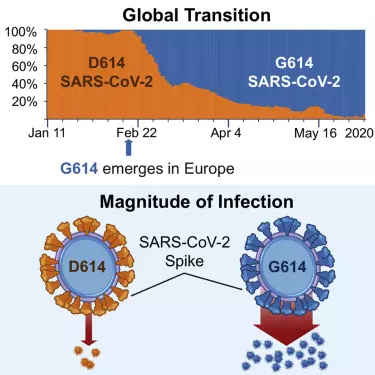
Transition and global magnitude of the D614G variant. Image adapted from Korber et al, 2020.
1. Understanding the D614G Mutation
The D614G mutation is physically located deep within the S1 subunit of the viral Spike protein.
The Mechanics of Viral Entry
The S protein monomer functionally consists of two active subunits:
- The S1 subunit: Directly responsible for aggressively binding the host receptor.
- The S2 subunit: Mechanically facilitates the complex fusion of the viral envelope and the host cell membranes.
These S protein monomers actively combine to form the highly distinctive homotrimers which physically project from the viral cell surface like a crown. Viral entry into the susceptible host cell is achieved almost exclusively via binding to the ACE2 receptors located heavily on the host cell membrane (4,5). The spike protein is incredibly immunogenic, meaning most of the vaccines and advanced therapeutic agents currently in global development specifically target this exposed region.
2. SARS-CoV-2 Spike Protein D614G Variant
Biorbyt is extremely proud to announce the launch of a novel, highly engineered research tool to aid virologists: the recombinant full-length trimeric soluble SARS-CoV-2 Spike protein D614G variant.
This is a highly soluble recombinant protein strictly featuring a stable foldon trimerization motif, a deliberately mutated Furin recognition site to prevent unwanted cleavage, and 2 critical stabilizing mutations (K986P and V987P). The physical design of this protein is based heavily upon and modified from the groundbreaking structural work by Amanat et al., 2020 (3).
3. Focus on Quality & Specifications
The highly validated recombinant full-length trimeric SARS-CoV-2 Spike protein, D614G variant (amino acids 16-1213) is strictly produced in mammalian HEK293 cells to ensure appropriate native glycosylation profiles, and is supplied conveniently in a stable liquid format.
| Specification | Details |
|---|---|
| Expression System | Mammalian HEK293 cells |
| Format | Liquid |
| Endotoxin Level | Less than 0.1 ng/μg (1 IEU/μg) |
| Purity | >90% as estimated by standard SDS-PAGE |
| Tag | C-terminal 8x histidine (His) Tag added for ease of purification and downstream assay use |
| Engineered Mutations | D614G, K986P, V987P, and a mutated Furin recognition site |
4. References
- Korber et al., Tracking Changes in SARS-CoV-2 Spike: Evidence that D614G Increases Infectivity of the COVID-19 Virus, Cell (2020). https://doi.org/10.1016/j.cell.2020.06.043
- Grubaugh et al., Making Sense of Mutation: What D614G Means for the COVID-19 Pandemic Remains Unclear, Cell (2020). https://doi.org/10.1016/j.cell.2020.06.040
- Amanat, F., Stadlbauer, D., Strohmeier, S., et al. A serological assay to detect SARS-CoV-2 seroconversion in humans. Nat Med., 2020;26:1033–1036.
- Walls et al., Structure, Function, and Antigenicity of the SARS-CoV-2 Spike Glycoprotein 2020, Cell, 180, 281–292.
- Hoffmann M., Kleine-Weber H., Schroeder S., et al. SARS-CoV-2 Cell Entry Depends on ACE2 and TMPRSS2 and Is Blocked by a Clinically Proven Protease Inhibitor. Cell, 2020;181(2):271-280.