
You have no items in your shopping cart.
Technical Support & Protocols
Peptide Solubility Guidelines
A comprehensive guide to predicting net peptide charge, choosing optimal solvents, and avoiding experimental sample loss.
Determining the ideal solvent for peptide dissolution can pose a serious challenge to researchers. Improper solubilization techniques can lead to irreversible aggregation, structural degradation, or severe sample loss.
While many synthetic and natural peptides exhibit excellent solubility in standard aqueous buffers, others encounter low solubility or total insolubility—particularly sequences containing long stretches of hydrophobic amino acid residues. To maximize recovery, always perform a initial solubility test on a tiny aliquot of peptide before attempting to dissolve the entire batch.
How to Calculate Overall Peptide Charge
Before selecting a solvent, estimate the net charge of your peptide sequence at physiological pH (pH ~7.0):
- Assign a value of -1 to each acidic residue (Asp [D], Glu [E]) and the free C-terminal carboxyl group (-COOH).
- Assign a value of +1 to each basic residue (Arg [R], Lys [K], His [H]) and the free N-terminal amino group (-NH2).
- Sum the values to calculate the overall net charge of the peptide sequence.
| Acidic Residues (-1) | Basic Residues (+1) |
|---|---|
| Aspartate (Asp / D), Glutamate (Glu / E), C-terminal (-COOH) | Arginine (Arg / R), Lysine (Lys / K), Histidine (His / H), N-terminal (-NH2) |
1. Solubilization Decision Rules by Net Charge
Positive Net Charge (Basic Peptides)
First, attempt to dissolve the peptide in sterile, distilled water or low-salt aqueous buffer.
- If the peptide does not dissolve, add a small volume of 10%–30% acetic acid solution.
- If the peptide remains insoluble, use trifluoroacetic acid (TFA, < 50 μl) to fully solubilize the core, then dilute with sterile water to the required working concentration.
Negative Net Charge (Acidic Peptides)
First, attempt to dissolve the peptide in sterile, distilled water or neutral buffer.
- If the peptide does not dissolve, add a small volume of 10% ammonium hydroxide (NH4OH, < 50 μl) or 10% NH4HCO3, then dilute with sterile water.
- Critical Exception: If the acidic peptide contains Cysteine (C) residues, do not use basic solutions as high pH accelerates disulfide bond formation and oxidative dimerization. Use neutral organic solvents instead.
Neutral Net Charge / Hydrophobic Peptides
Peptides with a net charge of zero or high hydrophobic content require organic co-solvents.
- First, attempt dissolution using acetonitrile, methanol, or isopropanol co-solvent mixtures.
- For highly hydrophobic sequences, dissolve the peptide in a minimal volume of 100% DMSO, then slowly dilute with aqueous buffer to the desired concentration.
- Cysteine-Containing Sequences: Use dimethylformamide (DMF) instead of DMSO, as DMSO can oxidize free thiol (-SH) groups on cysteine.
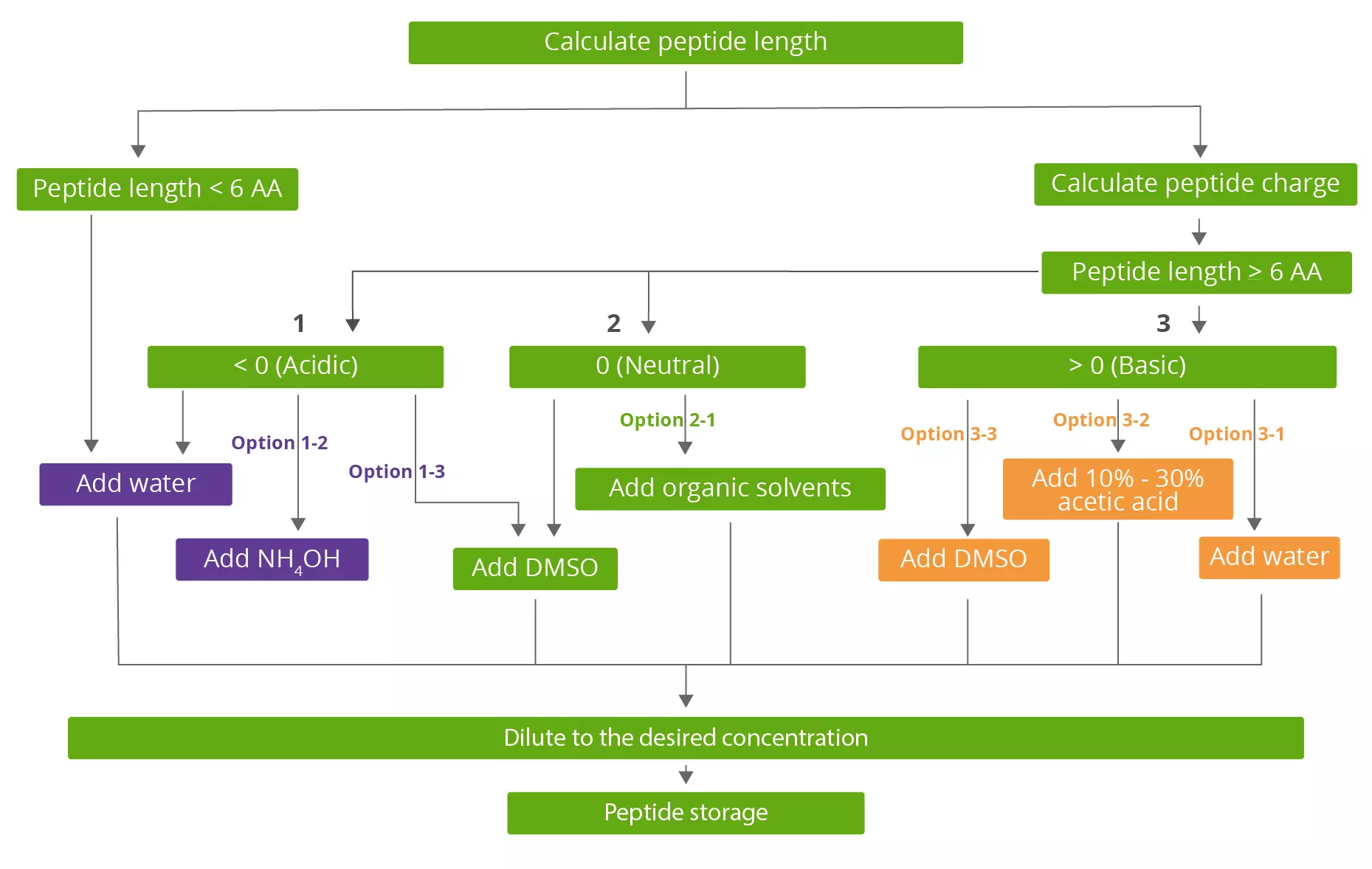
2. Peptide Dissolving Workflow
Refer to the decision tree below for a visual step-by-step solubilization routine:
Need Help Calculating Molarity & Concentrations?
Accurate concentration calculations are vital when reconstituting lyophilized peptides. Use a verified bio-molarity tool to determine exact solvent volumes based on molecular weight (MW) and target molarity.
3. General Guidelines & Best Practices
- Short Peptides (< 5 Residues): Shorter sequences are usually soluble in water or aqueous buffers, unless the entire sequence consists of strictly hydrophobic amino acids (e.g., Leu, Ile, Val, Phe).
- Sequence Composition Rule: Hydrophilic peptides containing > 25% charged residues (K, R, H, D, E) and < 25% hydrophobic amino acids dissolve readily in water or PBS. Sequences with ≥ 50% hydrophobic residues are frequently insoluble in purely aqueous media.
- Handling Aggregation-Prone Sequences: For stubborn, aggregate-prone peptides, dissolve in 6 M Guanidine-HCl or 8 M Urea, then proceed with gradual aqueous dilutions into assay buffer.
- Gentle Sonication & Warmth: Sonication in a water bath for 1–2 minutes or mild warming (< 40°C) can accelerate dissolution without denaturing the peptide backbone.
4. Peptide Sequence Characteristics Table
Understanding residue properties helps anticipate solubility limits, chemical stability, and potential degradation pathways:
| Peptide Solubility Classification | |
|---|---|
| Hydrophilic Residues | Asp (D), Glu (E), His (H), Lys (K), Gln (Q), Arg (R), Ser (S), Thr (T), Hydroxyproline, Pyroglutamic acid |
| Hydrophobic Residues | Ala (A), Phe (F), Ile (I), Leu (L), Met (M), Pro (P), Val (V), Trp (W), Tyr (Y), α-aminobutyric acid, Norleucine |
| Peptide Chemical Stability Concerns | |
| Oxidation (Mild Conditions) | Cys (C), Met (M) — Avoid DMSO when dissolving cysteine-containing peptides to prevent disulfide crosslinking. |
| Deamidation & Cyclization | Asn (N), Gln (Q), N-terminal Gln (can cyclize to pyroglutamate under acidic conditions), Asn-Gly motifs. |
| Photodegradation / Cleavage | Met (M), Trp (W) — Sensitive to light and atmospheric oxidation; store solutions in aliquots under inert gas when possible. |
| Residue Charge Contributions | |
| Positive Charge (+1) | Lys (K), Arg (R), His (H), Free N-terminus |
| Negative Charge (-1) | Asp (D), Glu (E), Tyr (Y - weak at high pH), Free C-terminus |
5. Advanced Handling & Storage Guidelines
To maintain peptide stability and prevent degradation over extended storage periods, follow these recent technical recommendations:
- Lyophilized Powder Storage: Store dry lyophilized peptides at -20°C or -80°C in sealed containers with desiccant to prevent moisture absorption. Allow the vial to warm to room temperature before opening.
- Avoid Repeated Freeze-Thaw Cycles: Once reconstituted in solution, divide the peptide stock into single-use aliquots and freeze at -80°C. Avoid multiple freeze-thaw cycles as this causes peptide aggregation and degradation.
- Buffer pH and Salt Selection: High ionic strength (e.g., > 150 mM NaCl) can decrease the solubility of hydrophobic peptides. Reconstitute in pure solvent or low-salt water first before adding concentrated PBS or tissue culture media.
- Controlling Organic Solvent Concentrations: Ensure the final concentration of organic solvents (DMSO, DMF, Acetonitrile) in cell-based assays remains below toxic thresholds (typically < 0.1%–0.5% v/v DMSO for cell culture).
Please consult specific literature or product datasheets pertaining to your target peptide sequence, as the rules above represent general chemical guidelines.